
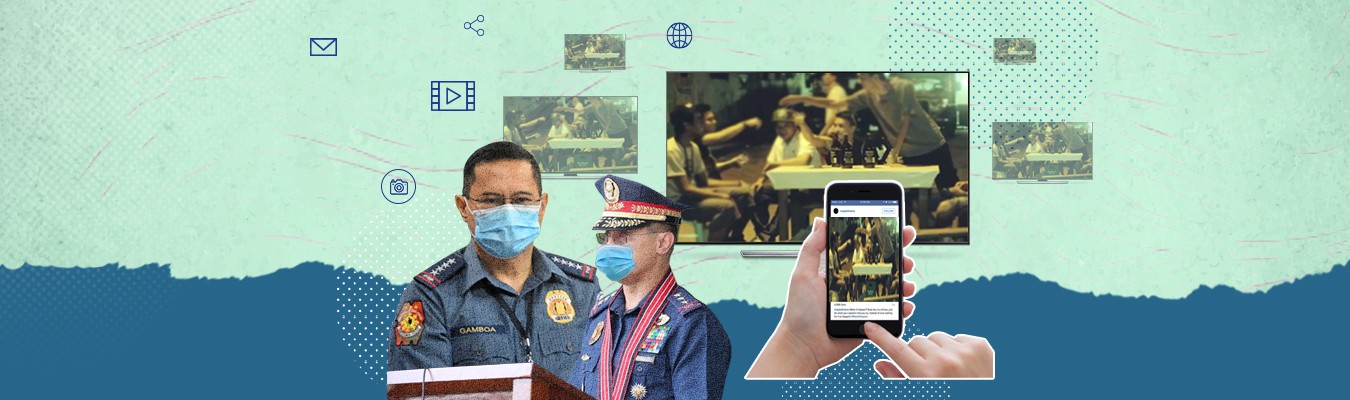
Recently, the Philippine National Police (PNP) made a statement to the effect saying that the police would be monitoring social media posts to determine compliance with community quarantine measures. This raised concern from a good number of people and for good reason. Issues on privacy were raised which constrained the PNP to clarify that they were to monitor only public posts. But the question remains, can the PNP legally monitor social media posts and could said posts be used as evidence in court?
The answer to the question is a bit tricky, especially given the pervasiveness of social media in our daily lives. Privacy of social media posts has always been difficult to navigate. However, the Supreme Court tried to navigate the murky waters of social media privacy and to a certain extent it succeeded. In the case of Vivares vs. St. Theresa’s College, et. al. (G.R. No. 202666, 29 September 2014.) the Supreme Court answered the question whether there is a reasonable expectation of privacy with regard to social media posts. The answer is, it depends.
As a brief background, the case is about photos posted by a group of students wearing only their undergarments. One of their teachers found out about the photos and reported it to the school administration. By way of punishment for their violation of the Student Handbook, the students in the photo posted were barred from participating in the school’s commencement exercises.
Note that in this case, the sanctions were because of photos posted by the students. The Supreme Court upheld the sanctions imposed by the school. It said that “Facebook was armed with different privacy tools designed to regulate the accessibility of a user’s profile” and it is up to the user to use these tools in order to control who can access and view any of their posts. The Court explained that “[t]he xxx privacy tools, available to Facebook users, [are] designed to set up barriers to broaden or limit the visibility of his or her specific profile content, statuses, and photos, among others, from another user’s point of view. In other words, Facebook extends its users an avenue to make the availability of their Facebook activities reflect their choice as to "when and to what extent to disclose facts about [themselves] – and to put others in the position of receiving such confidences." Ideally, the selected setting will be based on one’s desire to interact with others, coupled with the opposing need to withhold certain information as well as to regulate the spreading of his or her personal information. Needless to say, as the privacy setting becomes more limiting, fewer Facebook users can view that user’s particular post.”
It begs to reason therefore, that failure to use these tools would mean that there is no reasonable expectation of privacy when it comes to social media posts. The Court said “[b]efore one can have an expectation of privacy in his or her [online social network] activity, it is first necessary that said user xxx manifest the intention to keep certain posts private, through the employment of measures to prevent access thereto or to limit its visibility. And this intention can materialize in cyberspace through the utilization of the [online social network’s] privacy tools. In other words, utilization of these privacy tools is the manifestation, in cyber world, of the user’s invocation of his or her right to informational privacy”
The Supreme Court went further saying that given that the default setting for Facebook posts is “Public” and absent the use of the settings for privacy as provided for by Facebook then the one who posted cannot invoke informational privacy on said post. The Court, quoting the case of US vs. Gines-Perez, explained “[A] person who places a photograph on the Internet precisely intends to forsake and renounce all privacy rights to such imagery, particularly under circumstances such as here, where the Defendant did not employ protective measures or devices that would have controlled access to the Web page or the photograph itself.”
Now to the question of whether photos, or videos for that matter, posted on social media can be used as evidence in a case against an individual as what is PNP planning for quarantine violations. To answer this question, we need to look into the Rules on Electronic Evidence issued by the Supreme Court. For starters, Section 1, Rule 3 of the Rules states that “[w]henever a rule of evidence refers to the term of writing, document, record, instrument, memorandum or any other form of writing, such term shall be deemed to include an electronic document as defined in these Rules.” This is in consonance with the provisions of the E-Commerce Act, Section 12 of which states, “[i]n any legal proceedings, nothing in the application of the rules on evidence shall deny the admissibility of an electronic data message or electronic document in evidence (a) On the sole ground that it is in electronic form; or (b) On the ground that it is not in the standard written form, and the electronic data message or electronic document meeting, and complying with the requirements under Sections 6 or 7 hereof shall be the best evidence of the agreement and transaction contained therein.”
In other words, social media posts are considered as equivalent to their hardcopy counterparts. As such they can be used as evidence in a case involving the same subject of course to the rules of admissibility.
Do not get us wrong, we do not condone any violation of quarantine measures. It is after all designed to protect the health and promote the welfare of the population. However, in relation to social media posts, we leave you with these wise words of the Supreme Court:
“[Online social network] users should be aware of the risks that they expose themselves to whenever they engage in cyberspace activities. Accordingly, they should be cautious enough to control their privacy and to exercise sound discretion regarding how much information about themselves they are willing to give up. Internet consumers ought to be aware that, by entering or uploading any kind of data or information online, they are automatically and inevitably making it permanently available online, the perpetuation of which is outside the ambit of their control. Furthermore, and more importantly, information, otherwise private, voluntarily surrendered by them can be opened, read, or copied by third parties who may or may not be allowed access to such.
It is, thus, incumbent upon internet users to exercise due diligence in their online dealings and activities and must not be negligent in protecting their rights. Equity serves the vigilant. Demanding relief from the courts, as here, requires that claimants themselves take utmost care in safeguarding a right which they allege to have been violated. These are indispensable. We cannot afford protection to persons if they themselves did nothing to place the matter within the confines of their private zone. OSN users must be mindful enough to learn the use of privacy tools, to use them if they desire to keep the information private, and to keep track of changes in the available privacy settings, such as those of Facebook, especially because Facebook is notorious for changing these settings and the site's layout often.”
Disclaimer: The information presented in this article is for informational purposes only. It should not be taken as a legal advice or be used a basis for legal action or defense.
Related Reads
What's New
More Articles


