
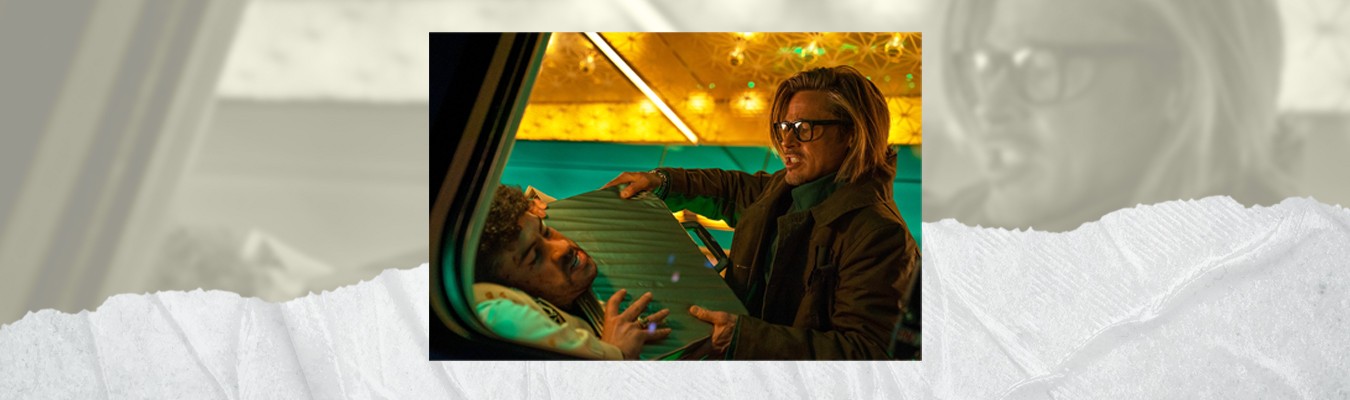
When Leitch first approached the prospect of directing Bullet Train, he admits that one of the biggest challenges would be how to create a compelling feature-length action film set in one contained environment. “As David was considering it, he thought, ‘How am I going to do action? The train is such a small space,’” says McCormick. “And I said, ‘Isn’t that an opportunity?’ That’s how we like to look at things – turning problems into opportunities.”
“The problem is we’re on a train, but the opportunity is we’re on a train,” Leitch explains. “When you confront yourself with problems, when you challenge yourself, when you put obstacles in front of yourself to design around, that’s when the choreography becomes more fun and fulfilling and creative. Instead of two people fighting in an arena, it’s now in the confines of the tube or the specificity of the dining car or the quiet car or the bathroom. You’re forced to find ways to make it interesting, and ultimately, through those challenges, you create better stuff.”
Designing the individual cars would be the role of production designer David Scheunemann, who says that he worked closely with director of photography Jonathan Sela from the very beginning. “Jonathan and I work very closely together from the minute we start a movie,” he says. “The only way to design a good set is to integrate every piece of lighting that you will need later on. It’s about crafting a set that works visually and technically on every level. Every single light source has been designed, tested, discussed, and built into the set piece to cover almost every scenario in Jonathan’s lighting design and David Leitch’s shot list.”
Scheunemann’s designs allowed for the two full-sized train cars that his construction team built to be interchangeable, allowing each train car to be redressed and repurposed to serve as multiple cars, including the family friendly Momomon-themed car. The special Momomon family car required extensive bespoke upgrades, such as an adhesive-backed hot pink skins affixed to both the interior and exterior of the train set to transform it into a brightly colored explosion of anime. Scheunemann’s keen attention to detail extended to conceptualizing the whole anime Momomon family of characters, even working with costume designer Sarah Evelyn to build a full-size costume for the Momomon character to interact with passengers.
And once in each of these environments, anything could be in play for the assassins to use in their trade. “You wouldn’t think there’d be so many weapons on a speeding train but we have guns, we have knives, we have samurai swords. And that’s just the beginning,” says Leitch. “There’s a snake, there’s a water bottle, there’s a laptop. There’s a broom handle and a kitchen knife duct taped together. There’s a cleaning solution. Even the Momomon suit gets in on the act.
How’d that happen? “That was one of those special discoveries,” Leitch continues. “In pre-production, Sarah Evelyn, our costume designer, had a photo of a guy trying to stuff a huge plushy inside of a train. We had pulled that photo to look at what he was wearing for wardrobe, but we kept returning to it – we all thought it was interesting. And we started connecting the dots – we had already been designing the Momomon car with the art department – we wondered, what if we could recreate this moment with the mascot? And what if one of the assassins was inside the mascot? These are some of the beautiful discoveries that you get when you have a great team of creatives that are willing to go on those little journeys with you and design along the way.”
Stage 26 on the Sony Lot housed the two train car sets, as well as a train station set, which Scheunemann’s team of artisan would redress as five different train stations. For Tokyo Station and its surroundings, the filmmakers reimagined and redressed the Los Angeles Convention Center as the station while a side street in downtown would be transformed into bustling Tokyo streets replete with flashing neon signs, food stalls, and market stands.
The screenplay for Bullet Train required a stylized, heightened, imagined vision of Japan, but also one that was respectful to the culture and felt honest. So, even as the filmmakers take definite liberties with its setting – making the creative decisions to design a setting that best suited the narrative and nature of the film – they did extensive research to make that vision a reality. For example, Academy Award®-nominated set decorator Elizabeth Keenan worked closely with a cultural advisor to ensure that everything – Tokyo, train stations, signage, dozens of different Japanese snacks, newspapers, magazines, vending machines, restaurants, and food kiosks – rang true.
Outside the windows of the train, this imaginary Japan passes by at 250 miles per hour. To create that, Leitch and his team used LED wall technology, which would surround the train cars to provide the enveloping backdrop of the Japanese landscape.
Visual effects supervisor Michael Brazelton and his team worked in tandem with Lux Machina, the company that designed and constructed the high-resolution interactive background of the LED wall. A separate Japan film unit would capture imagery with specialized array cameras filming routes similar to the Tokyo-Kyoto passage taken by the movie’s Shinkansen.
One key challenge for the Japan film unit was the inability to shoot on real moving bullet trains or even at train stations. The solution was to film on Japan’s freeways, traveling within posted speed limits that are significantly less than the 250 miles per hour that the bullet train can reach. With the footage in hand, technicians could speed it to the train’s proper velocity.
When displayed on the LED screens outside of Scheunemann’s windows, the team could sync up the train and the LED walls, which could move the image between First Class and Economy cars as intended. “We were able to do things we never thought we’d be able to do before,” says Brazelton.
“That was the biggest source of pressure for me – how do we sell the scope of our movie when we’re shooting in a sound stage on the Sony lot in two train cars that are supposed to feel like a twelve car train,” says Leitch. “The immersive environment for our actors was really helpful. Immediately you’re feeling the rhythm and the pace of the movie, instead of looking at a blue screen and trying to visualize it.”
Related Reads
What's New
More Articles


